AirAsia? HAHAHA


Night Elves (or "Kal'dorei" in their native tongue) have a skin color that ranges from deep lavender to marble white, extremely long (almost lagomorphic) ears, and hair in various cool-toned shades including blue, purple, green, white and black. The eyes of the males glow with a bright amber light, while those of the females glow a bright blue-white. The race is tall, with the men standing approximately 2.15 meters (7 feet) and females 2.0 meters (6.6 feet). The men are always of a slim-waisted yet rock-like, extremely muscular build including gigantic bear-like arms and hands. The women are much different, having a slim, athletic build. Unlike most other Elves, Night Elf men often have thick beards and bushy eyebrows. In Warcraft III, the Night Elves lived on the continent known as Kalimdor and were never seen by, and only known of by a few Orcs or Humans until they were introduced to the Warcraft Universe in Warcraft III: Reign of Chaos. In World of Warcraft, they live on the tree-island of Teldrassil, which is north and slightly west of Kalimdor.The greatest population of Night Elves reside in their capital city, Darnasses.
Many male elves are druids while many females become warriors in a group known as the "Sentinels." In World of Warcraft, however, both males and females can take on the role of druid, warrior, hunter, rogue or priest indiscriminately. In Warcraft III, the Night Elves were neutral but in World of Warcraft they have become a part of the Alliance. The night elf racial mounts are the Frostsaber (white tiger with either spots or stripes) and the Nightsaber (dark tiger available with stripes only). There is also another breed of rideable saber cats called a stormsaber; however, these epic mounts are only available at level 60. They can be purchased in Darnasses at 90 gold for an Apprentice and 900 gold for a Journeyman status. The other races of the Alliance can also learn how to ride a saber cat if they are exalted with Darnassus. In Warcraft III they also had a strange form of Hippogryph as well, it being raven and deer instead of the usual eagle and horse combination..
Before the end of Warcraft III all Night Elf druids were male, and slept for thousands of years in the Emerald Dream while the women were left to protect their slumber. This caused the females to become hardened. They were described by Grom Hellscream in Warcraft III as too savage to be High Elves.
In World of Warcraft, they seem to be the most populated race out of all races.
History
Night Elves were immortal until the destruction of the World Tree at the end of WarCraft III: Reign of Chaos. The forces of the Burning Legion had fought their way to the World Tree, which their commander, Archimonde, had set his sights upon. When Archimonde reached the tree, however, he discovered that he had walked into a trap set by Malfurion Stormrage. Thousands of wisps surrounded the Eredar and exploded all at once destroying him and damaging the World Tree. While this prevented Archimonde from destroying the world, it also deprived the Night Elves of the immortality that the tree had granted them. Not all of them adjusted to mortality well and many were terrified by the prospects of illness, ageing, and eventual death.
It wasn't long before some of the druids decided to make a new World Tree and thus regain their immortality; an idea that achieved popularity with many of the Kal'dorei. Malfurion warned them that such a selfish act would never be blessed by nature and forbade the creation of a new tree. After making this proclamation, Malfurion became trapped within the Emerald Dream and not even the green dragons who lived within the Emerald Dream could find him. With Malfurion incapacitated, leadership of the druids fell to Fandral Staghelm who was one of the Night Elves in favor of creating a new World Tree. Under Staghelm, a second tree was brought into existence and named Teldrassil. Unfortunately, Malfurion's prediction was correct; the new tree was not blessed by nature and the Night Elves did not gain new immortality from its creation as intended. The new World Tree radiated corruption that drove creatures and people inhabiting the area mad and filled them with mindless aggression. This is just one example of the negative effects Teldrassil has had on the world around it. Teldrassil's one positive effect is the wonderous city of Darnassus that was built upon it.
After the wars played in Warcraft III and Frozen Throne, which caused the destruction of most of the High Elves, the Night Elves are the most numerous Elven race in the world of Azeroth.
Highborne
The Highborne (Quel'dorei in elven tongue) were the personal servants of Queen Azshara in Kalimdor. Upon discovery of the Well of Eternity, they began to probe the well for secrets to discover the nature of its power. However the Highborne began to spend large amounts of time around it and it began to adversely affect them. Many began to shy away from speaking with the other Night Elves outside of the Highborne circle and increasingly delved into work concerning the Well. After much study, Queen Azshara encountered and made a pact with Sargeras, leader of the Burning Legion. In return for untold power, Azshara and the Highborne would open a portal into Azeroth for Sargeras and his minions. Sargeras rewarded several Highborne with a new more powerful form: the Satyr. However Malfurion Stormrage, with the help of Tyrande Whisperwind, Cenarius, and fellow Night Elves were able to drive the Burning Legion back. But because the summoning was interrupted the spell went awry and resulted in a terrible explosion that destroyed part of the land of Kalimdor, giving away to the Maelstrom. After the terrible destruction Malfurion and his followers reached the mainland with a few remnants of the Highborne. Malfurion did not punish them; he was content that the surviving Highborne could do no more damage without the Well's power. The ones that survived eventually left, under the leadership of Dath'Remar, to look for a new home. However Queen Azshara and some of her followers survived the explosion and sank to the bottom of the sea eventually mutating into the Naga. And there they remained until contacted centuries later by the Betrayer, Illidan.
Highborne ruins dot the lands of Kalimdor from Darkshore all the way to Azshara (the land named after the Highborne queen). Bashal'Aran and Ameth'Aran in Darkshore are the ruins of two large Highborne settlements that are occupied now only by demons and the tormented spirits of the Highborne. The Ruins of Eldareth in Azshara are all that remains of the Highborne Night Elves' ancient capital city. It is now overrun with a tribe of the vile Naga known as the Spitelash. Perhaps the most intriguing Highborne ruin in Kalimdor is Dire Maul. At the height of Highborne power, Dire Maul was known as the city of Eldre'Thalas, inside whose high walls were guarded many of Queen Azshara's most prized and powerful arcane secrets. Though it was ravaged by the Great Sundering of the world, much of the ancient city still stands. The three distinct districts of the city are overrun with a variety of dangerous creatures including Highborne spectres, demonic satyrs, and the Gordok Ogre tribe.
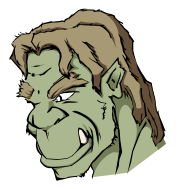
Orc is a word used to refer to various tough and warlike humanoid creatures in various fantasy settings, particularly in the stories of Middle-earth written by J. R. R. Tolkien and derivative fictions. Orcs are commonly portrayed as misshapen humanoids with brutal, warmongering, sadistic, yet cowardly tendencies. They are variously portrayed as physically stronger or weaker than humans, but always high in numbers. They often ride wolves or wargs.
Undead is the collective name for all types of supernatural entities that are deceased yet behave as if alive. Undead may be spiritual, such as ghosts, or corporeal, such as animated corpses. Undead are featured in the legends of most cultures and in many works of fiction, especially fantasy and horror fiction.Bram Stoker was the first to use the term "The Un-Dead" as the original title for his novel Dracula.[1] Stoker also uses the term in the novel.
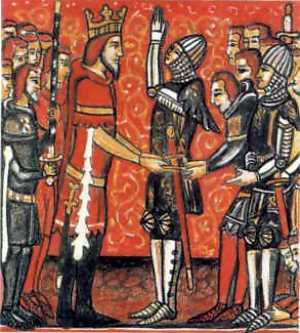
A paladin (alternatively paladine, also spelled palatine, or Latin palatinus, -i) is any of diverse officials found in numerous countries of medieval and early modern Europe.
It has existed in history first in Ancient Rome as an official of the Emperor as well as a corps of the praetorian guard (Diocletian), named after its neighboring Scholae Palatinae. In the early Middle Ages there was a papal church official or a noble close to the king (see below), in the late Middle Ages a synonym of count palatine, in Modernity it was in 19th century Hungary the supreme title given by the king or, in a broader sense especially around 1900 in Britain and the German Empire, a knight.
In fiction, the paladines were twelve heroes of mediaeval poetry, and in fiction it remains the meaning of “honourable knight”.
Derivative terms
The different spellings originate from the different languages that used the title throughout the ages (a phenomenon called lenition). The word "paladin" evolved from the Latin word palatinus, meaning "belonging to the Palatine Hill", where the house of the Roman emperor was situated since Octavian. The meaning of the term changed only little, but was changed to the pronunciation of the European languages: Latin palatinus, plural palatini, English paladin and paladine, French palaisin and German Paladin. The term was also adopted to describe the residence of the Ancient Roman palatinus, the palatium. In the early Middle Ages the German “paladin” was the elector of the King, given the palatinate to have a territory as a basis to sustain him (Pfalz).
The word palace also developed from “palatium”, so that a paladin was in one sense a palace official. Other uses are the titles of "mayor of the palace" and "count palatine". The original Middle French form is palaisin. The English paladin was loaned into Early Modern English from the Italian form, paladino, because late medieval treatments of the "Matter of France" were mostly by Italian authors such as Ludovico Ariosto and Matteo Maria Boiardo.
Ancient Rome
The Scholae Palatinae, named after its location on Palatine Hill, the mythical founding place of Rome, was the older of two schools of the ancient Salii brotherhood of God of War Mars, which lent some of their symbols to the emperial, later the papal palace.
Originally the term was applied to the chamberlains and to some troops guarding the palace of the Roman emperor. In Constantine's time, the title was also used for the most advanced field force of the army, the Praetorian Guard, that might guard the Roman Emperor on campaigns. The traditions of the two groups of 12 Salii priests and of the Praetorian Guard soon merged into one, creating an image of an influential official with nonphysical connotations
Middle Ages: Holy Roman Empire
From the Middle Ages on, the term palatine was applied to various different officials across Europe. The most important of these was the count palatine, who in Merovingian and Carolingian times (5th through 10th century) was an official of the sovereign's household, in particular of his court of law. The count palatine was the official representative at proceedings of the court such as oath takings or judicial sentences and was in charge of the records of those developments. At first he examined cases in the king's court and was authorized to carry out the decisions, in time, these rights extended to having own judicial rights. In addition to those responsibilities, the count palatine had administrative functions, especially concerning the king's household.
After Carolingean times France was split from the Holy Roman Empire, and under the German kings of the Saxon and Salian dynasties (10th to 12th century), the function of the counts palatine corresponded to those of the missi dominici at the Carolingian Court. They had various tasks: representatives of the king in the provinces, they were responsible for the administration of the royal domain and for the protecting and guiding the legal system in certain duchies, such as Saxony and Bavaria, and, in particular, Lotharingia. Later other palatine rights were absorbed by ducal dynasties, by local families, or, in Italy, by bishops. Increasigly, the count palatine of Lotharingia, whose office had been attached to the royal palace at Aachen from the 10th century onward, became the real successor to the Carolingian count palatine. From his office grew the Countship Palatine of the Rhine, or simply the Palatinate, which became a great territorial power from the time of the emperor Frederick I Barbarossa (d. 1190) on. The term palatine reoccurs under Charles IV, but they had only voluntary jurisdiction and some honorific functions.
The word palatinus and its derivatives also translate the titles of certain great functionaries in eastern Europe, such as the Polish wojewoda, a military governor of a province.
Middle Ages: Catholic Church
For the main article, see Palatinus (Roman Catholic Church)
In the Middle Ages, the judices palatini ('[papal] palace judges') were the highest administrative officers of the pope's household; with the growth of the temporal power of the popes they acquired great importance.
Early Modern Usage
In England the term palatinate, or county palatine, was applied to counties of lords who could exercise powers normally reserved to the crown. Likewise, there were palatine provinces among the English colonies in North America: Cecilius Calvert, Lord Baltimore, was granted palatine rights in Maryland in 1632, as were the proprietors of the Carolinas in 1663.[1]
19th and 20th century
In Germany and Britain, paladin was an official rank and considered an honorary title for one in service of the emperors. It was a Knight with additional honours.
During the second reinstating of a German Empire called the Third Reich, Hermann Göring was also given the title “Paladin”, referring to the tradition of a title that made the carrier second to the king.
Source: wikipedia
However, through my few years playing experiences, there are some rules to be observed, which may help you to increase your probability to win the game.
1) Never TP away
Do not teleport your entire team or your dying hero away while you engaged in fighting. This will cause your teammate to be left alone to fight with stronger party out there. Keep observing, unless some one who started to TP away, or typing B B B, then only you run. You can be pro-active to ask people who run too
2) Never fight alone
Do not be hero and fight alone with others. This is common even in arranged team game
3) Look at resources
Keep a look of your partner resources and encourage them to produce unit or share the gold
4) Expend New Gold Mine
Depends on the situation, if you noticed that your team mate had expended their base, you shall not expend another gold mine too. This will cause the entire team weaken to fight with others at certain period of time
5) Self Sufficient
Build something that you shall ensure that you will be self-sufficient to produce the unit. Never expect your team mate will share their resources and some time even lumbers.
6) Adjustment
Try to build something which adjust to your team mate, even though you are not happy to build certain unit. For example, if you notice that no one has actually building melee unit, you shall take the lead to make melee unit. Do not stick on the way you build and shall be more tolerate.
Feel free to visit The_Chieftain's friend racing website if you are the kaki of car modders and car racing... See u at Sepang !
http://www.leadracing.blogspot.com/
Many claims that garg is the useless unit to be used by Undead. I partially agree. Mainly people will start to produce garg when they lost majority of their anti air unit and then realised that the opponents have a bunch of air unit. Some time, if the player realised it early, then they still may manage to turn the game and become the winner, however, from what I notice in past 3 years, many dont.
Garg is useful mainly in random team big map especially with 2 night-elf in the opponent side. In most of the random team games, players like to tech and play by their own either creeping or doing nothing. Then when time come, a single war wil determine who is the winner.
Most of the elf player like to tech to chima, especially when there is more than 1 elf in a team and big map. Most player need a big map then only can comfortably to tech to chima, as they may be stupid and need longer time to produce the them. As such, actually it is quite useful and powerful to produce Garg in your entire RT game. However, dun try it in the 2v2 or in the 3v3 Arrange Team game. For arranged team game, you may try it in 4v4 game.
YOUR GUIDE FOR STAYING HEALTHY
WHAT IS ‘HAZE’?
Haze is a phenomenon or occurrence caused by the accumulation of fine particles in the air which are barely visible to naked eye. These particles may occur naturally or may be an outcome of human activities like open burning or smoky discharges from factories and exhaust of motor vehicles. When these particles accumulate in large quantities and suspend in the air, they can lock out sunlight and visibility will be greatly reduced.
AIR POLLUTANT INDEX (API)
The API is obtained from the measurement of fine particles (below 10 microns) and several gases which are hazardous to health such as carbon monoxide, sulphur dioxide, nitrogen dioxide and ozone. The API is used as a guide for measuring air quality and its effect on health as follows:-
API VALUE STATUS
0 - 50 - Good
51 - 100 - Moderate
101 - 200 - Unhealthy
201 - 300 - Very unhealthy
301 - 500 - Dangerous
HAZE THREATENS YOUR HEALTH
Continuous hazy conditions will cause ill effects to all people especially those in the high risk groups such as:-
1. Children
2. The elderly
3. Those with illnesses like
asthma
bronchitis
pneumonia
chronic lung diseases
heart diseases
allergies
4. Cigarette smokers
5. Those who work outdoors most of the time
WHAT ARE THE SYMPTOMS OF HEALTH PROBLEMS AS A RESULT OF EXPOSURE TO THE HAZE?
The effects of continuous exposure to the haze include:-
· Itchy sensation in the throat, and coughing, increased phlegm
· Difficulty in breathing (wheeze) or nose block
· Pain, irritation, red and watery eyes
· Itchy skin rashes
If above symptoms persist, get advice and treatment at the nearest clinic.
PREVENTION OF HAZE-RELATED ILLNESSES
· Close all windows and doors to your bedroom. Boil a kettle (electric) of water in the room and allow the steam to fill the room. Allow 10 – 15 minutes for the fine water vapor (steam) to collect the pollutants / particles in the air and settle down. After this the room should contain healthier air.
· Surgical masks are of no use and if not regularly changed they can act as a base for bacteria to grow and result in other infections. Only very close fitting masks that do not allow air to enter through the sides of the mask are effective.
· Limit all outdoor activity as far as possible e.g avoid outdoor sport or physical activities.
· Always wash / bathe as soon as you return from outdoors. This will minimize eye / skin irritation. For minor eye irritation try using over the counter eye drops e.g Eye Mo.
· Use your car air-conditioner when traveling in the car.
· Drink a lot of water.
· Smokers are advised to quit smoking.
· Those who suffer from diseases such as flu, bronchitis, asthma, conjunctivitis, heart diseases or chronic lung diseases should seek immediate treatment at the clinic or hospital if their condition worsens.


