Which is your favourite race in AT?

Wednesday, January 31, 2007

Warcraft 3 Maphack 1.21 (Version Jan 2007)

Warcraft 3 Maphack 1.21 (Version Jan 2007) is now available here.

(1) I have store the Maphack in my Car's forum
(2) After clicking the below, you will see one registration page
(3) Register to the forum and you wil able to see the thread of the Maphack, and you will see a link to Download.

Please click HERE to download for free.

Tuesday, January 02, 2007

Clan Bala 3rd Generation Forum

Clan BALA is going to launch its 3rd generation forum. It is currently under BETA version, the registered account will be converted to new forum.

Please log on and register at www.clan-bala.com/phpBB2/

Thursday, December 28, 2006

Wedding of the Year


Great pictures t share with Clan Bala's members, wish you a happy new year 2007.

Sperm

Wednesday, December 27, 2006

AMD PROCESSOR CHART

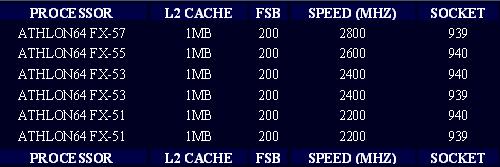
AMD ATHLON64 FX PROCESSOR CHART
"The AMD Athlon™ 64 FX processor features innovative technology to provide extraordinary performance and a gaming experience without parallel. The AMD Athlon 64 FX processor runs on AMD64 Technology, a revolutionary technology that 1) allows the processor to run 32-bit applications at full speed while enabling the coming wave of powerful, 64-bit software applications, and 2) provides Enhanced Virus Protection when supported by the OS*. AMD64 technology shatters barriers to new and advanced software that require 64-bit technology and blazing processor performance. Power-hungry enthusiasts and gamers can explore the full potential of AMD64 technology while enjoying outstanding performance on today's PC software."


AMD ATHLON64 X2 DUAL CORE PROCESSOR CHART
"Frustrated by staring at the hourglass icon as soon as you try to work on more than three programs at once, especially when you’re working with digital media? Increase your performance by up to 80% with the AMD Athlon™ 64 X2 dual core processor. Work or play with multiple programs without any stalling or waiting. Dual-core technology is like having two processors, and two working together is better and faster than one working alone."


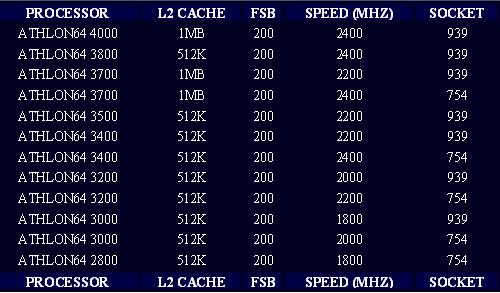
AMD ATHLON64 PROCESSOR CHART
"AMD's Athlon 64 is the latest evolution in the desktop computer industry. With its revolutionary 64bit architecture this CPU is fully compatible with future 64 bit operating systems and offers blistering performance in current 32 bit applications. With AMD's new HyperTransport technology and a massive 512kb L2 cache."


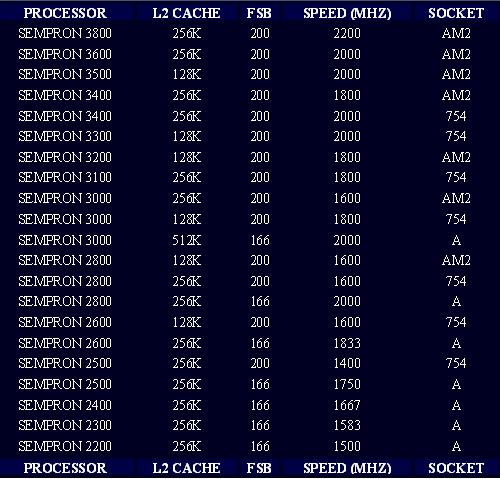
AMD SEMPRON PROCESSOR CHART
"AMD Sempron processors for desktop and mobile products offer best in class performance, compatibility with all the applications you need, and the reliability of AMD processors. Best-in-class performance for everyday computing. The AMD Sempron™ processor performs at the top of its class when running the home and business applications that you need most. Full-featured to improve your computing experience. The AMD Sempron™ processor lets you enjoy a dynamic Internet experience with smooth streaming video and audio."

Tuesday, December 26, 2006

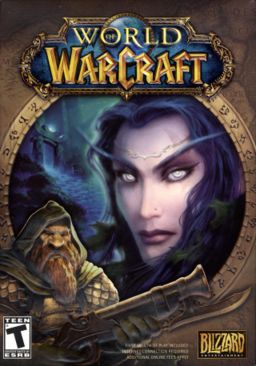
Release Dates of World of Warcraft


November 12, 2004
Korea

November 23, 2004
USA, Canada, Australia, New Zealand, Mexico

February 11, 2005
European Union

June 6, 2005
China

July 21, 2005
Singapore

November 8, 2005
Taiwan, Hong Kong, Macau

August 1, 2006
South Africa

History of Real Time Strategy (RTS)


1983 – 1992: the beginning

In the UK, the genre's beginning can be traced to Stonkers by John Gibson, published in 1983 by Imagine Software for the ZX Spectrum, and Nether Earth published on ZX Spectrum in 1987. In North America, the first game retrospectively classified as real-time strategy by most sources[1] is The Ancient Art of War (1984), designed by Evryware's Dave and Barry Murry, followed by the sequel The Ancient Art of War at Sea in 1987. Some writers list Intellivision's Utopia by Don Daglow (1982) as the first real-time strategy game.[2]
None of these titles would today be recognized as real-time strategy games. However, Herzog Zwei for the Sega Genesis in 1989 and Battle Master for the Amiga and Atari ST in 1990 are perhaps the earliest examples of relatively full-featured real-time strategy games.[3][4] Real-time strategy became recognized as a genre with the release of Dune II from Westwood Studios in 1992. Dune II also was the first to create a format for real-time strategy games that is still used today, such as using the mouse to move units, and gathering resouces.[citation needed]

1992 – 1998:
defining the popular perception of real-time strategy games

Dune II (1992) - The game that defined the real-time strategy genre
Although real-time strategy games have an extensive history, some titles have served to define the popular perception of the genre and expectations of real-time strategy titles more than others, and the games released between 1992 and 1998 by Blizzard Entertainment and Westwood Studios have, in particular, contributed to this. Westwood's Dune II: The Building of a Dynasty (1992) introduced in one sweep all the core concepts of modern real-time strategy games,[5] and as such acted as the first significant prototype for the "modern" real-time strategy game with the features described in the definition above.
While Westwood Studios laid the foundation and provided the prototype for real-time strategy games with Dune II, Blizzard Entertainment, between 1994 and 1998, can be argued to be responsible for establishing the form and content of the genre as understood today. The company's famous Warcraft series, Warcraft: Orcs & Humans (1994) and its sequel Warcraft II: Tides of Darkness (1995), refined the concepts introduced in Dune II. Westwood's Command & Conquer (1995) and Command & Conquer: Red Alert (1996), and Blizzard's StarCraft (1998), which were extremely popular, as well as the innovative, and Total Annihilation and Dark Reign, cemented the genre and provided a de facto standard against which new real-time strategy games are still measured.[citation needed]

1998 - present
Refinement of gameplay and ongoing transition to 3D graphics


Battle scene from Sierra's Homeworld (1999).
The real-time strategy genre has been relatively stable since 1995 and additions to the genre's concept in newer games tend to be introducing more units, larger maps, 3D terrain and similar, rather than innovations to the game concept with new games generally focus on refining aspects of successful predecessors.[citation needed] As the paragon example of gameplay refinement, Cavedog Entertainment's acclaimed Total Annihilation from 1997 distilled the core mechanics of Command & Conquer, and introduced the first 3D units in real-time strategy games. In 1997, Microsoft tried to combine elements of Civilization with the real-time strategy concept in Age of Empires by introducing ages of technologies, a combination refined further by Stainless Steel Studios' Empire Earth in 2001. GSC Gameworld's Cossacks: European Wars series took the genre in a different direction, bringing population caps into the tens of thousands.
Populous: The Beginning (1998) and Homeworld (1999) were the first completely 3D real-time strategy titles. Warcraft III (2002) is probably the most successful early 3D RTS. It is only in approximately 2002 that 3D real-time strategy became the standard, with both Warcraft III and Ensemble Studio's Age of Mythology being built on a full 3D game engine.
Relatively few genres have emerged from or in competition with real-time strategy games, although Real-time tactics, a superficially similar genre, emerged around 1995 and in 1998 Activision attempted to combine the real-time strategy and first-person shooter genres in Battlezone and Rage Games Limited attempted this also, with the Hostile Waters (2002) games.


Maphack

A maphack is a cheat in real-time strategy games that enables the player to see more of the map than the game intends them to see. A common feature in multiplayer real-time strategy games is the inability for the player to see outside the visibility range of the individual units and buildings that the player controls. This concept is called the fog of war or the Blue Fog of Death. Maphacking enables a cheating player to bypass the fog of war, giving them an advantage over a player who is playing legitimately. This advantage is quite large for most of the real-time strategy games that rely on the rock-paper-scissors dynamic to balance out the units' varying strengths and weaknesses.

Maphacking has also been used to cheat in other games where map visibility provides an advantage, most notably in Blizzard Entertainment's RPG Diablo II.
The maphack is functionally equivalent to a form of the wallhack for first-person shooter games which allows players to see through walls.

ShadowFrench
In Warcraft III the most popular version of the Maphack is created by ShadowFrench. ShadowFrench's maphack allows users to see the entire map, detect invisible units, detect clones, change the camera angle, display Hit point bars and enables resource trading in custom maps with resource trade locks. This maphack is detectable by Blizzard's Warden anti-cheat program.

ZoiD
ZoiD's maphack(zMap) had several features ShadowFrench's maphack did not. It allowed the user to see hero movement lines, and had a feature that made the player's workers go to the gold mine when the game started. This maphack was not detectable by Blizzard's Warden anti-cheat program. This maphack does not work in the latest patch, and is no longer in production.

In recent years people using maphacks on Battle.net have been caught, maphacking is a violation of Blizzard Entertainment terms of use, which condemns the use of any third party software. Thousands have had their accounts banned and in extreme cases, those caught cheating have had their CD key banned.